AI visibility tools are software platforms that track how often, how prominently, and how accurately your brand appears in answers generated by AI engines such as ChatGPT, Perplexity, Google AI Overviews, Gemini, and Copilot. They measure brand mentions, source citations, share of voice against competitors, and the sentiment of how models describe you. Rank trackers told you where you stood in Google’s ten blue links; AI visibility tools tell you where you stand inside the answer itself.
If buyers in your category ask AI assistants “what’s the best tool for X” — and in 2026 they do — you need two things: a tracker that measures whether AI engines mention you, and a content engine that produces the material they can cite. This guide compares the 10 best options for both jobs, with verified pricing as of mid-2026, honest limitations, and a workflow for pairing them. Last updated July 2, 2026.
Why does AI visibility suddenly matter?
Because the click is disappearing while the answer is exploding. Three verified shifts, all hedged to their sources:
- Zero-click search is now the majority. Roughly 65% of Google searches end without a click to any external website, per 2026 industry studies; SparkToro reported in 2026 that less than one third of Google searches still send a click to the open web.
- AI Overviews suppress organic clicks. A Seer Interactive study from late 2025 measured organic CTR falling about 61% on queries where an AI Overview appears, and AI Overviews have been reported on roughly half of tracked US queries.
- Answer engines are now discovery surfaces. ChatGPT passed a reported 900 million weekly active users in 2026, and Perplexity, Gemini, and Copilot each handle meaningful research and buying queries daily.
The upside is real too: one 2026 study reported that brands cited inside AI Overviews earn about 35% more organic clicks than uncited brands on the same queries. Vendors have noticed — the AI visibility category reportedly raised over $300M in funding between mid-2025 and spring 2026. If you want the strategic background before the tool list, read our guides on AEO vs SEO and LLM SEO.
How we evaluated these tools
We scored each platform on six criteria, weighted for what founders and small marketing teams actually need:
- Platform coverage — does it track ChatGPT, Perplexity, Google AI Overviews, Gemini, and Copilot, or only a subset?
- Citation tracking — does it show which of your pages AI engines cite as sources, not just brand name-drops?
- Prompt monitoring — can you track the specific buyer questions that matter in your category, and how many prompts does the plan include?
- Sentiment analysis — does it tell you how models describe your brand, not just whether they do?
- Price — verified list pricing as of mid-2026, including the add-ons you realistically need.
- Fit for startups — can a one-person marketing team get value in week one without an enterprise onboarding call?
One honest note on scope: nine of the ten tools below are trackers — they measure. One (our own Growthrik AI) is a content engine — it produces. We’ve ranked the trackers on merit and placed our tool where it honestly belongs in the workflow. For the broader tooling landscape beyond visibility tracking, see our AEO tools guide.
What are the best AI visibility tools in 2026?
1. Profound — the enterprise category leader
Profound is the most complete AI visibility platform on the market and the category’s reference point. It tracks brand mentions and citations across ChatGPT, Perplexity, Google AI Overviews, Copilot, and more, with answer-level analytics, competitor share of voice, and agent traffic analysis. The company has reportedly raised $155M at a $1B valuation and serves Fortune 500 clients.
- Pricing: reported from about $499/mo for the Lite plan as of mid-2026; enterprise tiers are custom.
- Strengths: deepest feature set, broadest engine coverage, strong citation and sentiment analytics, enterprise-grade reporting.
- Limitations: the price floor is roughly 17x Otterly’s entry plan; overkill for a solo founder tracking 20 prompts.
- Best for: enterprises and well-funded startups where AI visibility is a board-level metric.
2. Peec AI — the mid-market favorite
Peec AI is the fastest-growing mid-market option, reportedly reaching $4M+ ARR within ten months of launch and raising $29M. It offers clean prompt-level dashboards, competitor benchmarking, and agency workspaces, with a self-serve signup that takes minutes.
- Pricing: from €89/mo (about $95) for Starter, with Pro and Advanced tiers reported around €199–€495/mo as of mid-2026. Self-serve plans have been reported as limited to three AI engines, with extra engines available as paid add-ons.
- Strengths: fast setup, excellent competitor share-of-voice views, agency-friendly multi-workspace support.
- Limitations: prompt caps and engine limits on lower tiers mean real coverage costs more than the sticker price.
- Best for: marketing teams and SEO agencies that need serious tracking without enterprise procurement.
3. Otterly.AI — the affordable dedicated tracker
Otterly.AI, founded in Austria in 2024 and named a Gartner Cool Vendor in 2025, is the cheapest credible way to get continuous AI visibility monitoring. It tracks brand mentions, link citations, and sentiment across ChatGPT, Perplexity, Google AI Overviews, and other engines.
- Pricing: $29/mo Lite (15 prompts), $189/mo Standard (100 prompts), $489/mo Premium (400 prompts) as of mid-2026, with annual discounts.
- Strengths: lowest entry price of any dedicated tracker, simple UI, covers the core engines even on Lite.
- Limitations: 15 prompts on Lite runs out fast; analytics depth trails Profound and Peec.
- Best for: founders and small teams buying their first AI visibility tool.
4. Semrush AI SEO toolkit — best add-on for Semrush users
Semrush’s AI SEO toolkit (also sold as the AI Visibility Toolkit) bolts answer-engine tracking onto the SEO suite you may already pay for. You get brand visibility across ChatGPT, Perplexity, and AI Overviews next to your existing keyword and competitor data.
- Pricing: reported at $99/mo per domain as an add-on to a Semrush subscription as of mid-2026 — a realistic all-in of roughly $240–$265/mo including the base plan.
- Strengths: one dashboard for classic SEO and AI visibility; no new vendor to onboard.
- Limitations: per-domain pricing adds up for multi-site operators; requires a Semrush base plan.
- Best for: teams already on Semrush who want AI tracking without a second tool.
5. Ahrefs Brand Radar — the biggest retrospective index
Ahrefs Brand Radar takes a different angle: instead of running your prompts on a schedule, it mines a massive stored index of AI answers, so you can see historical mentions, cited pages, and share of voice for any brand — including competitors you don’t own.
- Pricing: layered — an Ahrefs base plan (from $129/mo) plus AI indexes reported at $199/mo per platform or about $699/mo for all bundled; realistic full coverage has been estimated at $828+/mo as of mid-2026.
- Strengths: unmatched retrospective data, competitor analysis without their permission, integrates with Ahrefs backlink and keyword data.
- Limitations: the layered pricing gets expensive fast; custom prompt tracking is a separate add-on.
- Best for: SEO teams on Ahrefs that want historical depth and competitive intelligence.
6. Scrunch AI — the agent-experience platform
Scrunch AI goes beyond “are we mentioned” to “can AI agents actually use our site.” It tracks visibility across six-plus AI models with daily refresh and audits how AI crawlers and agents parse your pages — a bet on the agentic-search future.
- Pricing: reported tiers of about $300/mo Starter, $500/mo Growth, and $1,000/mo Pro as of mid-2026, with custom enterprise plans; SOC 2 compliant.
- Strengths: agent-readiness auditing nobody else does well, daily data refresh, strong enterprise posture.
- Limitations: the $300 floor prices out most solo founders.
- Best for: mid-market and enterprise teams preparing for AI agents as a traffic source.
7. AthenaHQ — the data-first option
AthenaHQ is built for teams that want raw data over dashboards-with-opinions: custom metric creation, flexible API access, and deep analytics on how models answer your category’s prompts.
- Pricing: reported at about $295/mo Starter and $595/mo Growth as of mid-2026, with custom enterprise pricing.
- Strengths: API and export flexibility, custom metrics, good fit for teams with an analyst.
- Limitations: less hand-holding; you need someone who enjoys spreadsheets.
- Best for: data-driven growth teams that pipe visibility data into their own reporting.
8. Evertune — brand perception and hallucination alerts
Evertune focuses on how AI models describe your brand: sentiment analysis, model-by-model perception tracking, and alerts when an engine hallucinates something false about you — a genuine reputational risk for consumer brands.
- Pricing: not publicly listed as of mid-2026; enterprise custom pricing.
- Strengths: the deepest sentiment and brand-perception analysis in the category; hallucination alerting.
- Limitations: opaque pricing and enterprise sales motion; not a self-serve founder tool.
- Best for: consumer brands and comms teams where AI misinformation is a real liability.
9. HubSpot AI Search Grader — the free baseline
HubSpot’s AI Search Grader gives you a free, instant snapshot of your brand’s visibility and sentiment in AI answers. It won’t replace continuous tracking, but it answers the first question every founder has: “do AI engines even know we exist?”
- Pricing: free grader; ongoing AI visibility monitoring has been reported at around $50/mo bundled into the HubSpot platform as of mid-2026.
- Strengths: free, zero setup, decent sentiment snapshot.
- Limitations: point-in-time grade rather than continuous prompt tracking; deeper monitoring pulls you into the HubSpot ecosystem.
- Best for: anyone who wants a baseline before spending a dollar.
10. Growthrik AI — the content engine that feeds the trackers
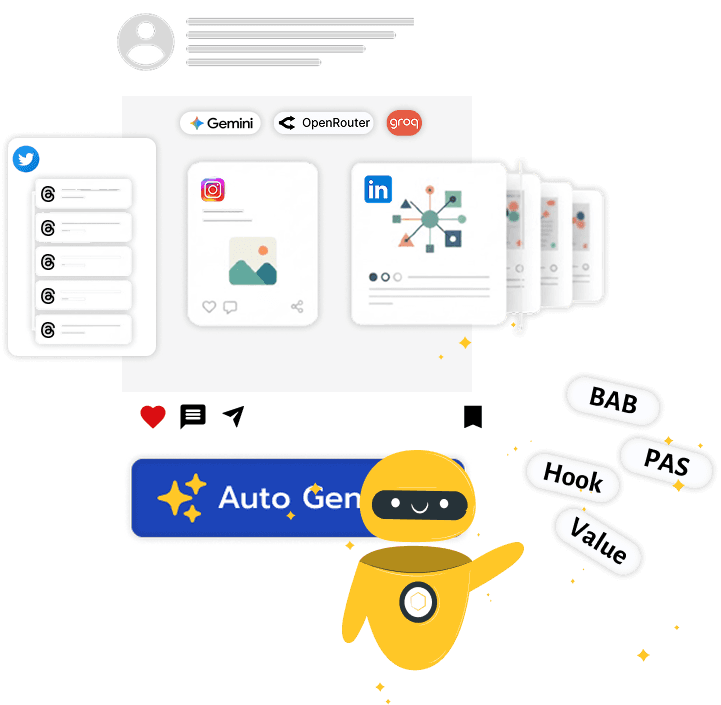
Full disclosure: Growthrik AI is our product, and it is not a citation tracker — it doesn’t monitor ChatGPT or measure share of voice, and we won’t pretend otherwise. It belongs on this list because every tracker above eventually tells you the same thing: you need more citable, consistent, brand-voiced content. Growthrik AI is the engine that produces it — a brand voice trained from your own posts in 5–10 minutes, 10 creative format variations in one click, and platform-native output for LinkedIn, X threads, Instagram, and reel scripts, with scheduling, repurposing, a humanizer, and multi-brand workspaces built in.
- Pricing: $19/mo Ignite → $49/mo Growth → $99/mo Scale, with a 60-day money-back guarantee. See full pricing.
- Strengths: the production side of AI visibility — volume, consistency, and brand voice across the platforms AI engines learn from.
- Limitations: no monitoring or citation tracking; pair it with any tracker above to measure results.
- Best for: founders, indie hackers, and one-person marketing teams who need to produce the content that moves the numbers.
How do the 10 tools compare at a glance?
Pricing below is list pricing as of mid-2026 and may change; “tracks” columns reflect vendor-stated coverage of ChatGPT / Perplexity / Google AI Overviews.
| Tool | Starting price | Tracks ChatGPT / Perplexity / AI Overviews | Sentiment | Best for |
|---|---|---|---|---|
| Profound | ~$499/mo | Yes / Yes / Yes | Yes | Enterprise & funded startups |
| Peec AI | ~€89/mo | Yes / Yes / Yes (engine limits by tier) | Yes | Marketing teams & agencies |
| Otterly.AI | $29/mo | Yes / Yes / Yes | Yes | First tracker for founders |
| Semrush AI SEO toolkit | $99/mo add-on | Yes / Yes / Yes | Yes | Existing Semrush users |
| Ahrefs Brand Radar | $199/mo per AI index + base plan | Yes / Yes / Yes | Limited | Historical & competitor data |
| Scrunch AI | ~$300/mo | Yes / Yes / Yes | Yes | Agent-readiness auditing |
| AthenaHQ | ~$295/mo | Yes / Yes / Yes | Yes | Data-first growth teams |
| Evertune | Custom (enterprise) | Yes / Yes / Varies | Yes (core strength) | Brand perception & comms |
| HubSpot AI Search Grader | Free | Snapshot only | Yes (snapshot) | Free baseline check |
| Growthrik AI | $19/mo | No — produces content, doesn’t track | No | Producing citable content |
How should you choose by team size and budget?
| Your situation | Measure with | Produce with | Realistic monthly cost |
|---|---|---|---|
| Solo founder, bootstrapped | HubSpot AI Search Grader (free) or Otterly.AI Lite ($29) | Growthrik AI Ignite ($19) | $19–$48 |
| Small team, 2–10 people | Peec AI (~€89) or Semrush AI toolkit ($99 add-on) | Growthrik AI Growth ($49) | ~$145–$315 |
| Agency managing clients | Peec AI or Otterly.AI Standard ($189) | Growthrik AI Scale ($99, multi-brand workspaces) | ~$195–$300 |
| Enterprise | Profound, Evertune, or full Ahrefs Brand Radar | In-house content team + tooling | $500–$1,150+ |
Three quick heuristics. If you haven’t checked your AI visibility at all, run the free HubSpot grade today — it takes minutes. If you can only spend $50/mo total, put $29 into Otterly and $19 into content production rather than $48 into tracking alone; measurement without production changes nothing. And if you’re choosing between Semrush and Ahrefs add-ons, pick whichever suite you already pay for — the switching cost outweighs the feature gap.
The workflow: measure with a tracker, produce with a content engine
Here’s the uncomfortable truth about every tool above: a tracker can tell you that Perplexity never cites you, but it cannot write the comparison page, the how-to guide, or the LinkedIn post that would change that. Measurement and production are different jobs, and the teams winning AI visibility in 2026 run both on a loop:
- Baseline (week 1): run HubSpot’s free grader, then set up 15–25 buyer prompts in Otterly.AI or Peec AI. Note where competitors get cited and you don’t.
- Produce (weeks 1–4): for each prompt you lose, publish answer-first content that directly addresses it — our guides on how to get cited by ChatGPT and Perplexity SEO cover the exact formats. Use Growthrik AI to turn each answer page into 10 platform-native variations — LinkedIn posts, X threads, Instagram captions — in your own brand voice, then schedule the rollout from the same calendar.
- Re-measure (weeks 4–8): watch citation and mention counts in your tracker. Double down on the prompt clusters where you gain ground.
The stack for a solo founder is $48/mo: Otterly.AI Lite to measure, Growthrik AI Ignite to produce. Both are cancel-anytime, and Growthrik comes with a 60-day money-back guarantee — see plans.
FAQ
What is the best AI visibility tool?
It depends on budget and team size. As of mid-2026, Profound is the strongest enterprise platform (reported from ~$499/mo), Peec AI leads the mid-market (from €89/mo), and Otterly.AI is the best affordable dedicated tracker ($29/mo). Founders on a tight budget can start with HubSpot’s free AI Search Grader for a baseline, then pair a tracker with a content engine like Growthrik AI ($19/mo) to improve the numbers the tracker reports.
What is AI visibility?
AI visibility is how often, how prominently, and how accurately your brand appears in answers generated by AI assistants and answer engines such as ChatGPT, Perplexity, Google AI Overviews, Gemini, and Copilot. It’s typically measured through brand mentions, citations of your pages as sources, share of voice against competitors, and the sentiment of how models describe you.
Are there free AI visibility tools?
Yes. HubSpot’s AI Search Grader is free and gives an instant snapshot of visibility and sentiment. Manually spot-checking your key prompts in ChatGPT and Perplexity costs nothing either. Continuous prompt tracking, competitor share of voice, and alerts generally require paid tools, which start at $29/mo with Otterly.AI as of mid-2026.
How much do AI visibility tools cost?
As of mid-2026: $29/mo for Otterly.AI Lite; roughly €89–€495/mo for Peec AI; about $99/mo for the Semrush AI toolkit add-on; roughly $295–$1,000/mo for AthenaHQ and Scrunch AI; and ~$499/mo up to custom enterprise pricing for Profound and Evertune. Full Ahrefs Brand Radar coverage has been reported at a realistic $828+/mo across all AI indexes.
What is the difference between an AI visibility tool and an SEO tool?
An SEO tool tracks where your pages rank on results pages and measures clicks. An AI visibility tool tracks whether your brand is mentioned or cited inside AI-generated answers — where there may be no ranked list and no click at all. The categories overlap (Semrush and Ahrefs now sell both), but AI visibility adds prompt-level monitoring and answer sentiment that rank trackers don’t cover. We break down the strategic difference in AEO vs SEO.
Does Growthrik AI track AI citations?
No. Growthrik AI is a content production engine, not a citation tracker. It trains a brand voice from your own posts in 5–10 minutes, generates 10 creative format variations per idea, and produces platform-native content AI engines can pick up and cite. To measure AI visibility, pair it with a tracker like Otterly.AI, Peec AI, or Profound; use Growthrik AI (from $19/mo, 60-day money-back guarantee) to produce the content that moves those numbers.
The bottom line
AI visibility tools answer a question SEO dashboards can’t: does ChatGPT recommend you? For most readers of this blog the practical picks are simple — Otterly.AI at $29/mo if you’re a founder, Peec AI from €89/mo if you’re a team, Profound from a reported ~$499/mo if you’re enterprise, and HubSpot’s free grader if you’re not sure you need any of this yet (you will be, quickly).
Just remember the half these tools don’t solve: trackers measure, they don’t produce. Pair whichever tracker you choose with a consistent content engine — Growthrik AI from $19/mo does that job for founders — and work the measure-produce loop. For where this all fits in a full-year plan, read our AI-driven SEO strategy for 2026.