
A 10,000-row keyword export is not a strategy. It is anxiety in spreadsheet form. Clustering turns that noise into a map: pillars, supporting articles, and the internal links that tie them together. Last refreshed April 21, 2026.
Why clusters beat piles of posts. Princeton’s GEO research (KDD 2024, Perplexity.ai) found that pages with cited sources earn +40% AI-citation visibility and pages with specific statistics earn +37%. Structured content — where one pillar anchors a topical cluster and internal links pass semantic context — compounds both classical rank and AI-answer citations. Google AI Overviews now appear in roughly 45% of searches (BrightEdge 2025), and for topic-intent queries the cited source is frequently a pillar inside a well-connected cluster rather than an isolated listicle. The clustering method below is designed for that reality.
Step 1 — Group by intent first
Before semantics, sort by what the searcher wants. Informational clusters feed education; commercial clusters feed demos and trials. Mixing them on one URL is how sites confuse both users and search engines.
Step 2 — Choose a pillar per cluster
The pillar should be the broadest term you can own with a definitive resource. Supporting pages tackle narrower queries that link back up. If two URLs fight for the same intent, merge or differentiate.
Step 3 — Name cannibalization early
Keyword cannibalization happens when multiple pages target the same intent. Use Search Console to see if Google alternates which URL it shows — a sign you need consolidation or clearer roles.
Step 4 — Let AI speed labeling, not judgment
Models are strong at proposing groupings and draft outlines. They are weaker at knowing your margin, your delivery capacity, and what sales actually closes. Use AI to compress busywork; you keep prioritization.
Step 5 — Tie clusters to production
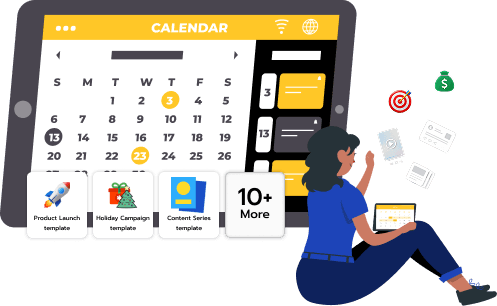
A map nobody ships is decoration. Connect each cluster to a brief, a draft date, and a distribution slice. Growthrik AI is built to bridge that gap — see AI-driven SEO strategy and content distribution loops.
Ready to grow traffic systematically? Read how to get organic traffic without ads, our SEO for startups playbook, or — if you run a SaaS — SaaS SEO, then try Growthrik AI.