
Social media marketing isn't optional in 2026 — it's the primary channel where brands build trust, generate leads, and drive revenue. Yet most businesses post randomly without a documented strategy. The result? Wasted hours, inconsistent branding, and zero ROI visibility.
This guide gives you the complete framework to build a social media marketing strategy that actually drives results. Whether you're a solo creator or managing a team, you'll walk away with a repeatable system. Last refreshed April 21, 2026 with 2026-current benchmarks.
Why a documented strategy moves the needle. Companies with a documented social media strategy are 313% more likely to report success than those without one (CoSchedule State of Marketing Strategy). On the discovery side, Google AI Overviews now appear in roughly 45% of searches and reduce traditional clicks by up to 58% (BrightEdge 2025; Advanced Web Ranking 2025) — so distribution is moving toward answer engines, not just feeds. The strategy below accounts for both surfaces.
Why You Need a Documented Social Media Strategy
Companies with a documented social media strategy are 313% more likely to report success than those without one. A strategy transforms social from a time sink into a predictable growth engine by answering three questions: Who are we talking to? What do we want them to do? How do we measure success?
Without a documented plan, every post is a coin flip. With one, each piece of content compounds — building brand recognition, nurturing trust, and moving your audience toward conversion.
Step 1: Audit Your Current Social Media Presence
Before building forward, take stock of where you are. A social media audit uncovers what's working, what's dead weight, and where competitors are outpacing you.
What to Audit
- Profile completeness — bio, links, profile image, and banner consistency across platforms
- Content performance — top 10 posts by engagement rate in the last 90 days
- Audience demographics — who actually follows you vs. your target customer
- Posting cadence — are you consistent or sporadic?
- Competitor analysis — what content types and frequencies work for 3-5 competitors?
Record everything in a spreadsheet. Patterns will emerge — perhaps video outperforms static images 3:1, or LinkedIn drives 60% of your website traffic while Instagram drives brand awareness but little conversion.
Step 2: Define SMART Goals
Vague goals like “grow our social media presence” lead to vague results. Use the SMART framework:
- Specific — “Increase LinkedIn engagement rate”
- Measurable — “from 2.1% to 4.0%”
- Achievable — based on industry benchmarks and current trajectory
- Relevant — tied to a business objective (lead generation, brand awareness, recruitment)
- Time-bound — “by Q3 2026”
Map each goal to a platform. LinkedIn for B2B lead gen, Instagram for brand awareness, X/Twitter for thought leadership, TikTok for reaching Gen Z.
Step 3: Know Your Audience Deeply
Great social media marketing starts with empathy, not content. Build 2-3 audience personas that capture:
- Job title, industry, and company size
- Pain points and daily frustrations
- Content formats they consume (short-form video, long-form articles, carousels)
- Platforms they spend time on (and when)
- Language and tone they respond to
Pro tip: Don't guess — look at your analytics. LinkedIn Page analytics, Instagram Insights, and X Analytics reveal exactly who your audience is. Growthrik AI's LinkedIn Previewer helps you test whether your hooks resonate before publishing.
Step 4: Choose Your Platforms Strategically
Being everywhere is a trap. In 2026, the smartest brands focus on 2-3 platforms where their audience actually lives and create content native to each platform's format.
| Platform | Best For | Content Format | Posting Frequency |
|---|---|---|---|
| B2B, thought leadership | Text posts, carousels, articles | 3-5x/week | |
| Brand awareness, e-commerce | Reels, Stories, carousels | 4-7x/week | |
| X / Twitter | Real-time, thought leadership | Threads, short-form text | 1-3x/day |
| TikTok | Gen Z, viral reach | Short-form video | 3-5x/week |
| Community, local business | Video, groups, events | 3-5x/week |
Step 5: Build Your Content Pillars
Content pillars are 3-5 recurring themes that every post maps to. They prevent random posting and ensure your feed tells a coherent brand story.
For a SaaS company, pillars might be: Product education, Customer success stories, Industry insights, Behind the scenes, and Thought leadership.
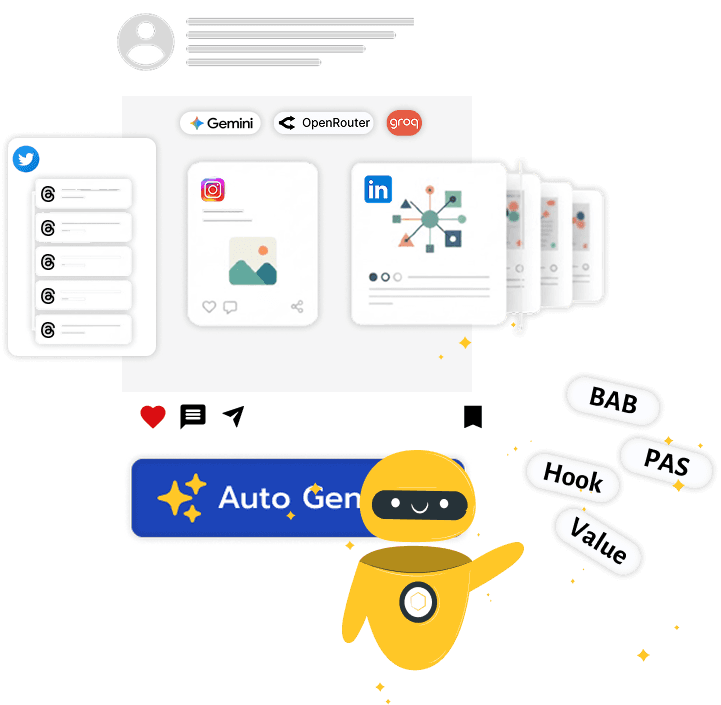
Once your pillars are defined, content creation becomes dramatically faster. Tools like Growthrik AI let you input an idea and generate platform-specific versions across all your pillars in seconds — maintaining your brand voice every time.
Step 6: Create a Content Calendar
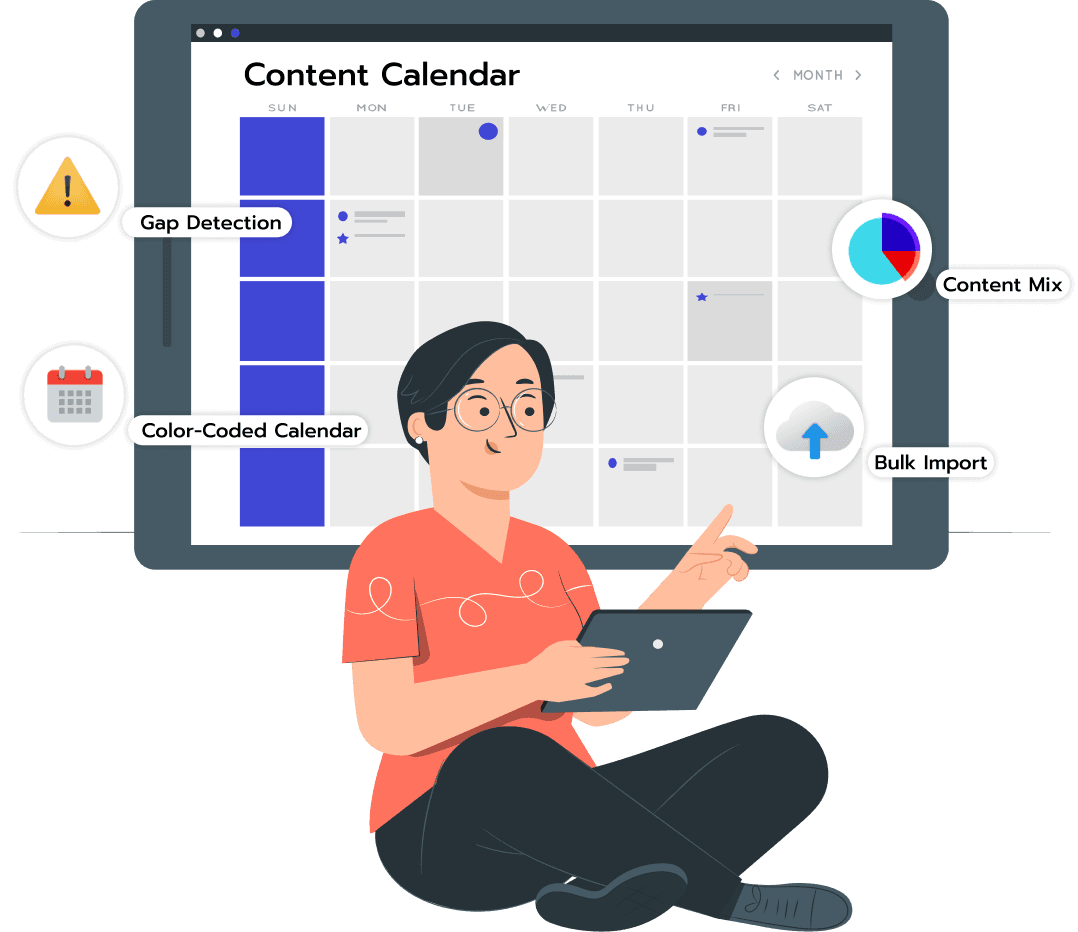
A social media content calendar transforms strategy into action. Map out content 2-4 weeks in advance, assigning each post a date, platform, pillar, format, and CTA.
Your calendar should include a mix of content types:
- 40% educational — how-tos, tips, frameworks
- 30% engaging — polls, questions, behind-the-scenes
- 20% promotional — product features, case studies, offers
- 10% curated — industry news, partner shoutouts
Growthrik AI's content calendar feature lets you plan, generate, and schedule all from one dashboard — no spreadsheet juggling required.
Step 7: Leverage AI for Content Creation
The biggest bottleneck in social media marketing is content production. In 2026, organic traffic playbooks that pair AI with distribution loops have moved from novelty to necessity.
The key differentiator? Brand voice preservation. Generic AI tools produce generic content. Growthrik AI's 7-part brand voice profile ensures every generated post sounds like your brand — not a robot. Input one idea, and Growthrik AI produces 10 platform-specific variations instantly.
This isn't about replacing human creativity. It's about eliminating the blank-page problem and letting marketers focus on strategy while AI handles the repetitive formatting, rephrasing, and platform optimization.
Step 8: Engage, Don't Just Broadcast
Social media is a two-way street. The algorithm rewards engagement — comments, shares, saves — not just impressions. Build engagement into your strategy:
- Reply to every comment within 2 hours
- Ask genuine questions in your posts
- Comment on 10-15 posts from your target audience daily
- Share and add value to industry conversations
- Use polls and interactive features
Step 9: Measure What Matters
Vanity metrics (followers, likes) feel good but rarely correlate with business outcomes. Track metrics tied to your SMART goals:
- Engagement rate — (likes + comments + shares) / impressions
- Click-through rate — link clicks / impressions
- Conversion rate — signups, demo requests, or purchases from social
- Share of voice — your mentions vs. competitors
- Content ROI — revenue attributed to social / cost of production
Review metrics weekly and adjust your content mix monthly. What gets measured gets improved.
Step 10: Iterate and Scale
A social media strategy is never “done.” Platforms change algorithms, audience preferences shift, and new formats emerge. Build quarterly reviews into your workflow:
- What content types drove the most engagement?
- Which platform delivered the best ROI?
- Where are competitors gaining ground?
- What new features can we leverage?
As you scale, invest in tools that reduce production time without sacrificing quality. See how the top AI social media tools compare to find the right fit for your team.
Frequently Asked Questions
What is a social media marketing strategy?
A social media marketing strategy is a documented plan that outlines your goals, target audience, content pillars, posting schedule, and KPIs for social media platforms. It turns random posting into systematic brand building that drives measurable business results.
How do I create a social media strategy from scratch?
Start with a brand audit, define SMART goals, research your audience, choose 2-3 platforms, establish content pillars, create a content calendar, and track metrics weekly. Tools like Growthrik AI can automate content generation across all platforms while preserving your brand voice.
How often should I post on social media in 2026?
Optimal posting frequency: LinkedIn 3-5x/week, Instagram 4-7x/week (including Reels and Stories), X/Twitter 1-3x/day, Facebook 3-5x/week. Consistency matters more than volume — use a content calendar and scheduling tools to maintain rhythm.
Can AI help with social media marketing strategy?
Absolutely. AI tools like Growthrik AI generate brand-voice-consistent content, repurpose one idea into 10+ platform-specific formats, suggest trending topics, and automate scheduling — saving marketers 10-15 hours per week on content production alone.